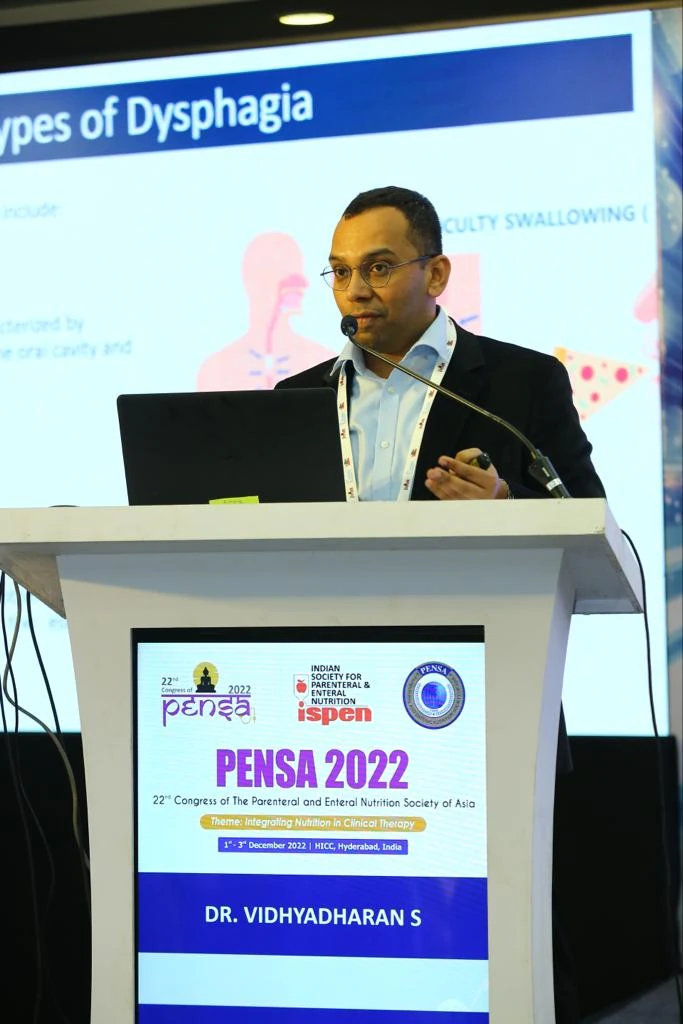
Your Swallowing Disorder Specialist

Dr. Vidhyadharan Sivakumar is a fellowship-trained head and neck surgeon with specialized expertise in diagnosing and treating swallowing disorders (dysphagia). Using advanced techniques including FEES (Fiberoptic Endoscopic Evaluation of Swallowing) and videofluoroscopy, he provides comprehensive care for patients with swallowing difficulties from various causes including stroke, cancer treatment, and neurological conditions.

With extensive experience in managing complex swallowing disorders, Dr. Vidhyadharan employs a multidisciplinary approach involving speech therapists, nutritionists, and rehabilitation specialists. His expertise includes both diagnostic evaluation and therapeutic interventions to restore safe swallowing and improve quality of life.

Credentials & Expertise

80% decannulation success rate | FEES & videofluoroscopy expertise | Post-stroke dysphagia specialist | Post-cancer treatment rehabilitation | TBI & head injury dysphagia | Geriatric swallowing care | Ryle's tube & feeding tube management | Pediatric swallowing disorders

Understanding Swallowing Disorders (Dysphagia)

Dysphagia is difficulty moving food or liquid safely from the mouth to the stomach. It can affect the mouth and throat stage (oropharyngeal dysphagia) or the food pipe stage (esophageal dysphagia). The most serious complication is aspiration — food or liquid entering the lungs — which can cause life-threatening pneumonia.

Swallowing disorders are common after head and neck cancer treatment, stroke, traumatic brain injury, and in elderly patients. They significantly impact quality of life, leading to social isolation, malnutrition, dehydration, and depression. Specialized swallowing rehabilitation guided by objective testing like FEES can help most patients return to safe oral feeding.

Causes & Risk Factors

1
Head & neck cancer treatment

Surgery or radiation causing fibrosis and reduced mobility

2
Stroke

The most common neurological cause of swallowing difficulty

3
Traumatic brain injury

Disrupts the complex neural coordination of swallowing

4
Parkinson's disease

Progressive neurodegeneration affecting swallowing muscles

5
Age-related weakening

Presbyphagia — gradual decline in swallowing strength and coordination

6
Zenker's diverticulum

Pouch forming in the upper esophagus trapping food

7
Cricopharyngeal dysfunction

Tight upper esophageal sphincter that fails to open properly

8
Vocal cord paralysis

Impaired airway protection during swallowing

9
Esophageal stricture

Narrowing from reflux, radiation, or caustic injury

10
Myasthenia gravis

Autoimmune condition causing fatiguable muscle weakness

11
Medications

Drugs causing dry mouth can impair swallowing function

How Are Swallowing Disorders Diagnosed?

Accurate diagnosis requires objective visualization of the swallowing process to determine the exact nature and severity of the problem, and to guide safe feeding recommendations.

FEES

Flexible Endoscopic Evaluation of Swallowing — gold standard, done in-office

Videofluoroscopy (VFSS)

Modified barium swallow — X-ray video of the swallowing process

Clinical bedside assessment

Initial screening of swallowing safety with different consistencies

FOIS scoring

Functional Oral Intake Scale to grade current eating ability

Sensory testing

Fiberoptic assessment of throat sensation and protective reflexes

Esophagoscopy

Direct visualization of the food pipe for structural causes

Manometry

Pressure measurement for esophageal motility disorders

Nutrition assessment

Evaluation of hydration, weight, and nutritional status

Conditions We Treat

Post-Stroke Dysphagia
Post-Cancer Treatment Swallowing Problems
Neurological Dysphagia (Parkinson's, ALS, MS)
Aspiration & Silent Aspiration
Pharyngeal Dysphagia
Esophageal Dysphagia
Cricopharyngeal Dysfunction
Zenker's Diverticulum
Post-Radiation Dysphagia
Post-Surgical Swallowing Problems
Head Injury / TBI-Related Dysphagia
Ryle's Tube & Feeding Tube Management
Globus Sensation (Lump in Throat)
Age-Related Swallowing Problems (Presbyphagia)
Geriatric Dysphagia & Dementia-Related Feeding Problems
Pediatric Swallowing Disorders

When to Seek Swallowing Evaluation

Consult Dr. Vidhyadharan if you experience:

Difficulty swallowing solids or liquids
Coughing or choking while eating
Food sticking in throat
Recurrent pneumonia
Weight loss due to eating difficulty
Pain when swallowing
Drooling or difficulty managing secretions
Voice change after swallowing
Prolonged meal times
Avoidance of certain foods
Sensation of lump in throat
Regurgitation of food
Children with feeding difficulties

Early diagnosis improves outcomes

Treatments

Dysphagia Diagnosis & Treatment

FEES (Fiberoptic Endoscopic Evaluation)

Direct visualization of swallowing using flexible endoscope. Identifies aspiration, residue, and swallowing mechanism problems. Safe, can be done at bedside, and provides immediate results for treatment planning.

Swallowing Therapy & Rehabilitation

Customized swallowing exercises, posture modifications, and diet texture adjustments. Collaboration with speech therapists for comprehensive rehabilitation program. Improves swallowing safety and efficiency.

Surgical Interventions

For structural problems, surgical options include cricopharyngeal myotomy for CP dysfunction, Zenker's diverticulum repair, or aspiration prevention procedures. Minimally invasive techniques when possible.

Aspiration Management

Strategies to prevent food/liquid entering airway. Includes diet modifications, swallowing maneuvers, positioning techniques, and in severe cases, temporary or permanent feeding tube placement with continued rehabilitation.

Why Choose

Why Choose Dr. Vidhyadharan

Fellowship-trained with extensive dysphagia management experience

Advanced diagnostic capabilities (FEES, videofluoroscopy)

Multidisciplinary team approach with speech therapists and nutritionists

Experience with post-stroke and post-cancer dysphagia

Both conservative and surgical treatment options

Focus on aspiration prevention and pneumonia reduction

Comprehensive rehabilitation programs

State-of-the-art facilities at THANC Hospital

Advanced Technology & Techniques

FEES (Fiberoptic Endoscopic Evaluation of Swallowing)Videofluoroscopic Swallow Study (VFSS)High-Definition Flexible EndoscopyManometryAdvanced Swallowing Therapy Equipment
Your Journey

Your Dysphagia Care Journey

Understanding what to expect helps reduce anxiety and prepares you for treatment

1

Comprehensive Swallowing Assessment

Detailed history of swallowing problems, clinical swallowing examination, and determination of need for instrumental evaluation (FEES or videofluoroscopy). Assessment of aspiration risk and nutritional status.

2

Instrumental Evaluation

FEES or videofluoroscopy performed to directly visualize swallowing mechanism. Testing with different food textures and liquid consistencies. Identification of specific swallowing problems and aspiration risk.

3

Treatment Plan Development

Based on findings, development of individualized treatment plan. May include diet modifications, swallowing strategies, therapy exercises, or surgical intervention. Discussion of timeline and expected outcomes.

4

Therapy & Intervention

Implementation of swallowing therapy with speech therapist. Regular monitoring of progress. Adjustment of diet texture and safety strategies. Surgical intervention if needed for structural problems.

5

Long-term Management

Regular follow-up to monitor progress. Gradual advancement of diet as swallowing improves. Maintenance exercises. Re-evaluation as needed. Goal of safe oral feeding and prevention of complications.

FAQs

Frequently Asked Questions

Dysphagia is difficulty swallowing. It can range from mild discomfort to life-threatening aspiration pneumonia. Serious complications include malnutrition, dehydration, and recurrent lung infections from aspiration. Early evaluation and treatment are important to prevent these complications.

FEES uses a flexible camera to view swallowing from inside the throat - no radiation, can be done at bedside, and shows actual swallowing in real-time. Videofluoroscopy is an X-ray study showing the entire swallowing process from mouth to stomach. Both are valuable; choice depends on individual patient needs and clinical question.

Many patients improve significantly with therapy and can return to normal or near-normal diet. Success depends on underlying cause, severity, and ability to participate in therapy. Post-stroke patients often see substantial improvement. Some conditions may require long-term diet modifications for safety. Realistic goals are set based on individual assessment.

Feeding tubes are recommended when oral intake is unsafe or inadequate for nutrition. They may be temporary (NG tube) or long-term (PEG tube). The goal is always to work toward safe oral feeding when possible. Many patients with feeding tubes can still eat small amounts by mouth while maintaining adequate nutrition through the tube.

Response to therapy varies by condition. Post-stroke patients may see improvement in weeks to months. Progressive neurological conditions require ongoing management. Most patients notice some improvement within 4-8 weeks of consistent therapy. Compliance with exercises and strategies is crucial for success.

Aspiration is when food, liquid, or saliva enters the airway instead of the esophagus. It can cause choking, coughing, and recurrent pneumonia. "Silent aspiration" occurs without coughing and is particularly dangerous. FEES or videofluoroscopy can detect aspiration, and therapy focuses on preventing it.

Some swallowing problems have surgical solutions - Zenker's diverticulum repair, cricopharyngeal myotomy for CP dysfunction, or dilation for strictures. However, most dysphagia requires therapy-based management. Surgery is considered when structural abnormality is identified or when therapy alone is insufficient.

Post-radiation dysphagia is challenging but treatable. Dr. Vidhyadharan has extensive experience with post-cancer treatment swallowing problems. Treatment includes aggressive swallowing therapy, dilation of strictures if needed, and nutritional support. Early intervention is important. Many patients achieve functional swallowing with comprehensive rehabilitation.

Post-stroke dysphagia occurs in 40-70% of stroke patients due to weakness or incoordination of swallowing muscles. Treatment includes comprehensive swallowing evaluation with FEES, modified diet textures (pureed, soft), swallowing exercises, compensatory strategies (chin tuck, head turn), and close monitoring for aspiration. Many stroke patients show significant improvement with intensive therapy in the first 3-6 months.

Cricopharyngeal dysfunction occurs when the upper esophageal sphincter (cricopharyngeus muscle) fails to relax properly during swallowing, causing food to stick in the throat. Treatment options include swallowing therapy, botox injection into the muscle, or cricopharyngeal myotomy (surgical division of the muscle). Dr. Vidhyadharan will determine the best approach based on severity and underlying cause.

Costs vary depending on the type of evaluation needed (FEES vs. videofluoroscopy), number of therapy sessions required, need for surgical intervention, and individual patient complexity. THANC Hospital and Dr. Vidhyadharan provide comprehensive swallowing disorder management with state-of-the-art diagnostic facilities at economical costs. Our team will provide detailed cost estimates based on your specific condition during consultation.

Diet modifications depend on swallowing assessment findings. Common modifications include thickened liquids (nectar, honey, pudding consistency) to slow flow and reduce aspiration risk, pureed or soft foods for chewing difficulties, moist foods to ease passage, avoiding mixed consistencies (soup with chunks), and small bite sizes. A speech therapist and nutritionist work together to ensure safe nutrition while maintaining adequate calories.

Yes. Swallowing disorders affect 25-60% of patients with traumatic brain injury (TBI). With structured FEES-guided rehabilitation, many TBI patients can regain functional swallowing and have their tracheostomy and feeding tubes removed. The first 6 months after injury represent the peak recovery window. Early referral for specialized swallowing assessment significantly improves outcomes.

A Ryle's tube (nasogastric or NG tube) is a thin flexible tube inserted through the nose into the stomach for temporary feeding when a patient cannot swallow safely. It is commonly placed after stroke, head injury, or surgery. For feeding needs beyond 4-6 weeks, conversion to a PEG tube (placed through the abdomen) is usually recommended for patient comfort. Dr. Vidhyadharan uses FEES to determine when it is safe to begin oral feeding and work toward tube removal.

Yes. Studies show 30-40% of adults over 65 experience some degree of swallowing difficulty (presbyphagia). Age-related changes include reduced muscle strength, slower reflexes, decreased saliva, and reduced sensation. These changes reduce the swallowing reserve, meaning any additional illness or medication can trigger clinical dysphagia. FEES evaluation can detect problems early and guide rehabilitation to prevent aspiration pneumonia.

Have more questions? We're here to help.

Schedule a Consultation
From Our Blog
Life After Feeding Tube: Cancer Swallowing Rehabilitation Guide
Swallowing Disorders

Life After Feeding Tube: Cancer Swallowing Rehabilitation Guide

For many head and neck cancer survivors, the feeding tube represents both a lifeline and a daily reminder of their battle. While it provides essential nutrition during and after treatment, the questio...

13 min readRead More
Geriatric Swallowing Disorders: Elderly Dysphagia Treatment
Swallowing Disorders

Geriatric Swallowing Disorders: Elderly Dysphagia Treatment

Swallowing difficulties in the elderly are far more common than most families realize — and far more dangerous than they appear. Studies consistently show that **30-40% of adults over 65 experience so...

11 min readRead More
Feeling a Lump in Your Throat? Causes, Diagnosis & Treatment
Swallowing Disorders

Feeling a Lump in Your Throat? Causes, Diagnosis & Treatment

Globus pharyngeus, often described as a "lump in throat" feeling, can be a frustrating and anxiety-provoking experience. This sensation, where you feel like something is stuck in your throat even when...

9 min readRead More
Head Injury & TBI Swallowing Disorders Treatment
Swallowing Disorders

Head Injury & TBI Swallowing Disorders Treatment

Traumatic brain injury (TBI) — from road traffic accidents, falls, workplace injuries, or assault — is one of the leading causes of disability in India. What many families and even referring physician...

10 min readRead More
Pediatric Swallowing Disorders & Feeding Difficulties
Swallowing Disorders

Pediatric Swallowing Disorders & Feeding Difficulties

When your child struggles to eat or drink, mealtimes can become stressful and worrying for the entire family. As a parent myself, I understand the anxiety of watching a child refuse food or choke duri...

14 min readRead More
Post-Stroke Dysphagia: Swallowing Rehabilitation in Chennai
Swallowing Disorders

Post-Stroke Dysphagia: Swallowing Rehabilitation in Chennai

Post-stroke dysphagia — difficulty swallowing after a stroke — is one of the most common yet underrecognized complications of stroke. Research consistently shows that **40-70% of acute stroke patients...

13 min readRead More

Get Expert Help for Swallowing Problems

Swallowing difficulties can be dangerous. Schedule your evaluation at THANC Hospital.